Professional work
The Data System Behind Elevate 2035
Building the data and review system that connects Daniels' Elevate 2035 strategy to measures, faculty evidence, department action, and Dean's Office review.
- Employer
- University of Denver — Daniels College of Business
- Dates
- July 2026 — Present
- Status
- Active
- Classification
- Professional work · Data Governance & Institutional Analytics
- Evidence
- Sanitized architecture diagram · 5-step method chain
- Role
- Manager, Data and Analytics
The Work in Four Facts
The problem. Daniels College of Business adopted the Elevate 2035 strategy, but the information needed to track it lived in separate systems that could answer the same question differently — definitions, sources, owners, and reporting periods unresolved.
What Kyle built. A centralized Supabase/Postgres reporting system that brings approved inputs from five source systems — Airtable, Watermark, Banner, Slate, and Salesforce — under agreed definitions, reporting rules, role-based views, and review workflows.
His role. As Manager, Data and Analytics at the University of Denver — Daniels College of Business, Kyle designs and implements the system: the data model, the reporting rules, the access model, and the review workflow.
The scope. Strategic measures, faculty evidence, department action, and Dean's Office review — three user groups reading role-appropriate views of one governed framework, live since July 2026 and deployed in stages.
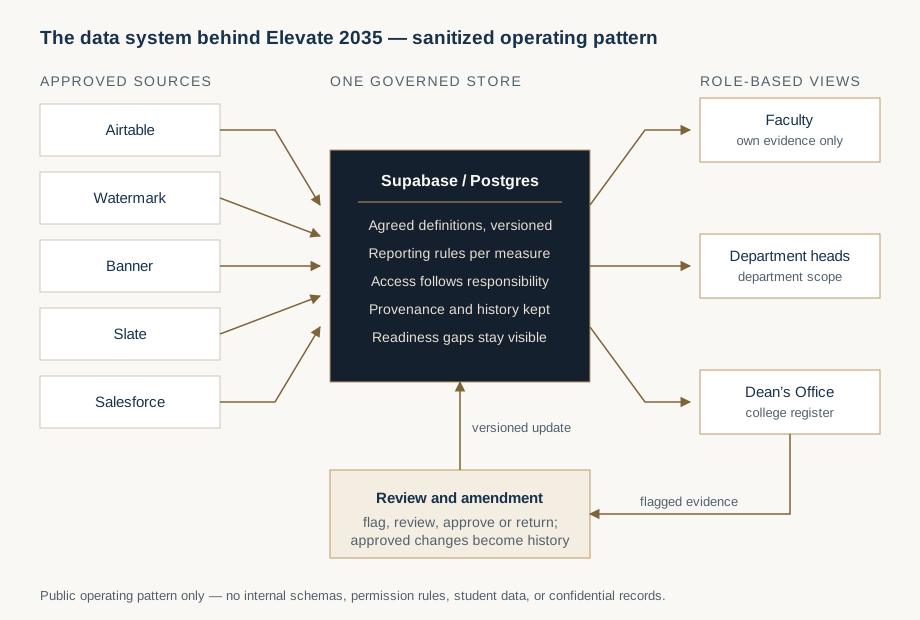
Read it left to right. Airtable, Watermark, Banner, Slate, and Salesforce are the five approved sources. Each lands in one Supabase/Postgres store that holds the agreed definitions, the reporting rules, the access model, and the provenance of every value. Faculty, department heads, and the Dean's Office each read that store through the view their role allows, and the review and amendment workflow returns approved changes to it as versioned history. The diagram is sanitized: it shows the operating pattern, not the college's internal architecture.
What the System Does
- Governs the strategic framework — versions, pillars, goals, measures, targets, observations, initiatives, and dependencies share one controlled structure.
- Enforces reporting rules — a measure reports a status only when it has an approved definition, an accountable custodian, a source of truth, a relevant reporting period, known exceptions, a current observation, and an approved target or comparison rule.
- Separates kinds of evidence — outcomes, delivery, contribution, and data readiness remain distinct measurement lenses rather than one collapsed percentage.
- Keeps readiness visible — missing definitions, custodians, sources, baselines, or approved targets appear as work to resolve, not as false performance signals.
Three User Groups, Three Views
Faculty members see their own evidence, initiatives, research, timeline, amendment history, and the strategic criteria used to organize that information.
Department heads see the evidence and decision work within their departments, with college-level context presented at an appropriate level of aggregation.
The Dean's Office sees the college register: strategic measures, readiness gaps, department contributions, initiative dependencies, evidence-review queues, and items awaiting judgment.
The same governed framework serves each audience without exposing information beyond that audience's responsibility.
Review Workflows
Definitions are versioned and historical observations are retained. Faculty can flag inaccurate or missing evidence; department heads review the request; the Dean's Office approves, returns, or rejects it. An approved amendment creates a new governed version while preserving the prior value and the decisions that produced the change.
Automation handles stable, repeatable steps with explicit inputs and reviewable outputs. It does not replace ownership when definitions conflict, classifications are ambiguous, or a consequential judgment is required.
Method chain
- Turn approved strategy language into agreed definitions and records with named owners.
- Reconcile each measure with its reporting period, custodian, source of truth, and known exceptions.
- Give faculty, department heads, and the Dean's Office each the evidence their role needs.
- Route incomplete, disputed, or consequential evidence through human review and escalation.
- Preserve provenance, decisions, and approved amendments as traceable institutional history.
Operating disciplines
- Data governance
- Institutional analytics
- Business intelligence
- Source validation
- Workflow automation
Method and boundaries
Method: Turn the college's written strategy into agreed definitions, checked evidence, the right access for each role, review, and follow-up with a named owner.
Disclosures and boundaries:
- This case study describes a confidentiality-safe operating pattern, not the college's internal architecture. No student data, internal schemas, permission rules, protected screenshots, confidential records, or unverified employer outcomes are published.
- This is active institutional work developed and validated in stages — not a completed performance scorecard, an HR system, a faculty-ranking product, or a public institutional database.